

Dd10 transformer test: connections and reading
Dd10 has a delta HV winding and a delta LV winding, with clock number 10: LV lags HV by 300° (the same as leading by 60°). Compact-3, our portable turns ratio instrument with 18 vector groups, checks it with three quick tests and shows a − sign when the transformer is correct.
| Vector group | Dd10 |
|---|---|
| HV / LV winding | Delta / delta |
| Clock number | 10 – LV lags HV by 300° (the same as leading by 60°) |
| Correct reading on Compact-3 | − (HT voltage around 180° from the LT excitation), shown in yellow |
| Tests | 3 (selector 1, 2, 3) |
How to connect
Connect the HT leads R, Y, B to the HV terminals (1U, 1V, 1W), and the LT leads r, y, b to the LV terminals (2u, 2v, 2w). Make the connections once; the three tests are selected with the selector, no re-connection is needed.
Select Dd10 as the vector group and enter the transformer’s calculated ratio (CR) from the nameplate.
Which windings are tested
Compact-3 applies a low voltage to one LT winding (the small letters) and measures the matching HT winding (the capital letters). The pairs for Dd10 are:
| Selector (sticker 1, 2, 3 / display R, Y, B) | LT winding excited | HT winding measured | What you should see |
|---|---|---|---|
| 1 (R) | ry | YB | − sign, in yellow |
| 2 (Y) | yb | BR | − sign, in yellow |
| 3 (B) | br | RY | − sign, in yellow |
What the instrument shows
Turn the selector to 1, then 2, then 3 (the display shows R, then Y, then B) and note the ratio, deviation and the angle shown on the display for each step.
 Selector 1 (R): LT ry, HT YB | 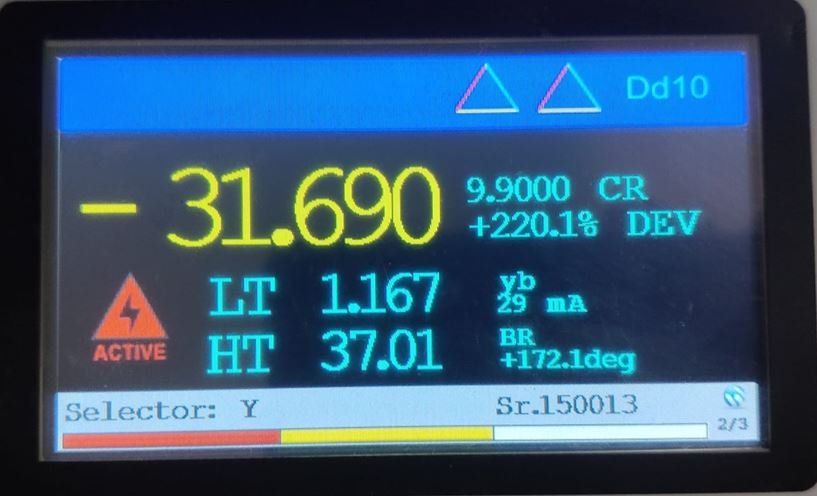 Selector 2 (Y): LT yb, HT BR | 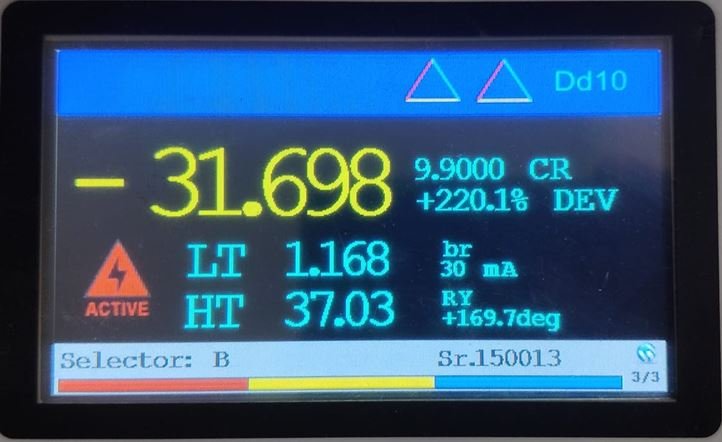 Selector 3 (B): LT br, HT RY |
For Dd10 the sign is − and the angle is around 180°. If the polarity is not what Dd10 expects, the sign turns red (+) instead of yellow: check the leads, the selected vector group and the transformer’s internal connection.
How it looks in the Compact-3 software
The same readings can be read on a PC with the Compact-3 TTR software, saved in the table and printed as a PDF report.
 Software, selector 1 (R) |  Software, selector 2 (Y) |  Software, selector 3 (B) |
Review page
After the three tests the review page on the instrument lists all readings together.

Winding and clock diagram

Dd10 and Dd4
Dd10 and Dd4 are tested on the same windings; only the expected sign is different: Dd10 shows −, Dd4 shows +. A wrong choice between the two is the most common reason for a red sign.
Questions and answers
Which phases does Compact-3 test for Dd10?
It tests LT ry against HT YB, LT yb against HT BR, LT br against HT RY. The selector moves through 1, 2 and 3 (shown as R, Y and B on the display); no re-connection is needed.
What reading is correct for Dd10?
A correct Dd10 shows a - sign in front of the ratio, in yellow, close to the calculated ratio, with the HT voltage around 180 degrees from the LT excitation.
Why does Compact-3 show a red sign for Dd10?
The polarity does not match Dd10. Check the lead connections, that Dd10 is the selected vector group and not Dd4, and the transformer's internal connection.
See all vector groups of Compact-3 in Vector groups explained. Product page: Compact-3.
Other instruments for transformer testing
A vector group test is usually done together with a ratio test and a winding resistance test. These are the instruments we make for them.
| Instrument | What it does |
|---|---|
| Compact-3 | Portable three-phase turns ratio instrument with battery backup. Tests all 18 vector groups in three steps. |
| VTRI-318S | Automatic turns ratio instrument, ratio 1-200 (1-2000 optional). Also supports all 18 vector groups. |
| TRM-1A | Transformer winding resistance meter (1 A) for fast and accurate winding resistance testing, up to 10 MVA. |
| TRM-10D | Dual-channel transformer winding resistance meter, 0.2 mΩ to 2 kΩ, up to 20 MVA. |
| DVDF Meter | Double voltage, double frequency meter for the induced-voltage test: replaces two meters with one, more accurate and simpler. |
Compact-3 and VTRI-318S both support all the vector groups on this page. For a price, a demo or help in choosing, please contact us.